In recent decades, the market has grown into a force that permeates everything. Capital and financial systems have gained unprecedented influence and seem increasingly detached from the society they were once meant to serve. From an evolutionary perspective, it’s a familiar pattern: systems that become too powerful eventually undermine themselves. At the same time, the role of the government has shifted, ethics in politics have faded, and the cohesion within our communities has weakened. The result? A society that is steadily drifting out of balance.
But this is not just about economics. The social and political debate, too, seems to have lost its equilibrium. Angered farmers block highways while climate activists glue themselves to the asphalt, two worlds that appear to understand each other less and less. In Parliament, harsh words dominate, and outside the political arena, elected officials receive threats instead of letters full of ideas. The tone is hardening; nuance is disappearing. Polarization widens the gap between groups, while our ability to truly listen to one another diminishes. Discussions increasingly revolve around short-term gain instead of moral direction or the common good. What does responsibility still mean when being right becomes more important than meeting the other in dialogue?
Yet the search for balance is not only a story of institutions and systems, it is also a story of people. How do we reconnect generations, social classes, and communities that seem to be drifting further apart? How do we turn tension and difference into an invitation for collective effort rather than a breaking point? As individuals, we, too, search for balance between work and rest, freedom and responsibility, ambition and meaning. In that personal search, the larger question of our time is reflected: how do we remain in balance when everything around us is in motion?
The question is not whether we are out of balance, but how we can restore equilibrium. What role should the market play in a society whose foundations it risks eroding? How do we rediscover ethics and trust in a political system that should unite rather than divide? And what strength can communities develop to bring us back together? In our own lives, we experience the same tension. We try to meet expectations, perform well at work, stay healthy and engaged and often become exhausted in the process. The search for balance is not only societal, but deeply personal: how do we stay upright in a world that never stops moving?
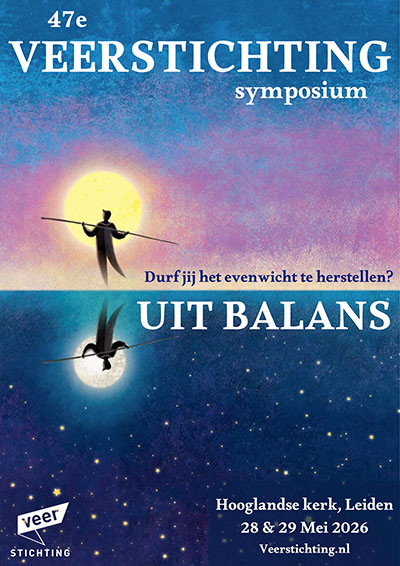
This year, the Veerstichting invites us to reassess the balance: to investigate where equilibrium was lost, who benefits from it, and how we can restore it together. Not only by analysing, but by taking responsibility, as citizens, as institutions, and as a generation. Because only through collective effort can a society remain standing.
Are you willing to restore the balance?